Fish Feeds Calculator: How to Feed Fish the Right Way
Choose your aquarium species — bettas, guppies, goldfish, tetras, cichlids, plecs, corydoras, clownfish, tangs, and 20 more — and Fishhear's feeding calculator returns a daily schedule, recommended food types in priority order, foods to avoid, and species-specific guidance. Adjusted for adults or juveniles. Built by an aquarist with 18 years at the glass.
Choose a species to see its feeding schedule, recommended foods, and what to avoid.
Feeding amounts are species-typical guidelines — observe your fish, watch for leftover food after 60–90 seconds, and adjust accordingly. Healthy fish are alert, well-coloured, and have flat (not concave or distended) bellies.
Feeding fish seems simple until you realize how much goes into it. Too much food clouds the water. Too little leaves fish hungry and weak. A Fish Feeds Calculator solves this problem by giving you exact amounts based on your fish type, size, and tank setup. This guide covers everything from portion sizes to food types so your fish stay healthy and your tank stays clean.
Fish Feeds Calculator
Our Fish Feeds Calculator takes the guesswork out of daily feeding. Enter your fish species, their size, and how many you keep. The calculator gives you precise amounts in grams or pieces. This works for freshwater tanks, saltwater setups, and ponds alike.
Here's what the calculator needs from you:
| Input | Why It Matters |
|---|---|
| Fish species | Different fish have different metabolisms |
| Fish size | Bigger fish need more food |
| Number of fish | Total portions depend on population |
| Water temperature | Warmer water increases appetite |
| Food type | Flakes, pellets, and frozen foods have different densities |
The calculator updates amounts as your fish grow. Use it weekly to keep portions accurate.
How Much to Feed Fish
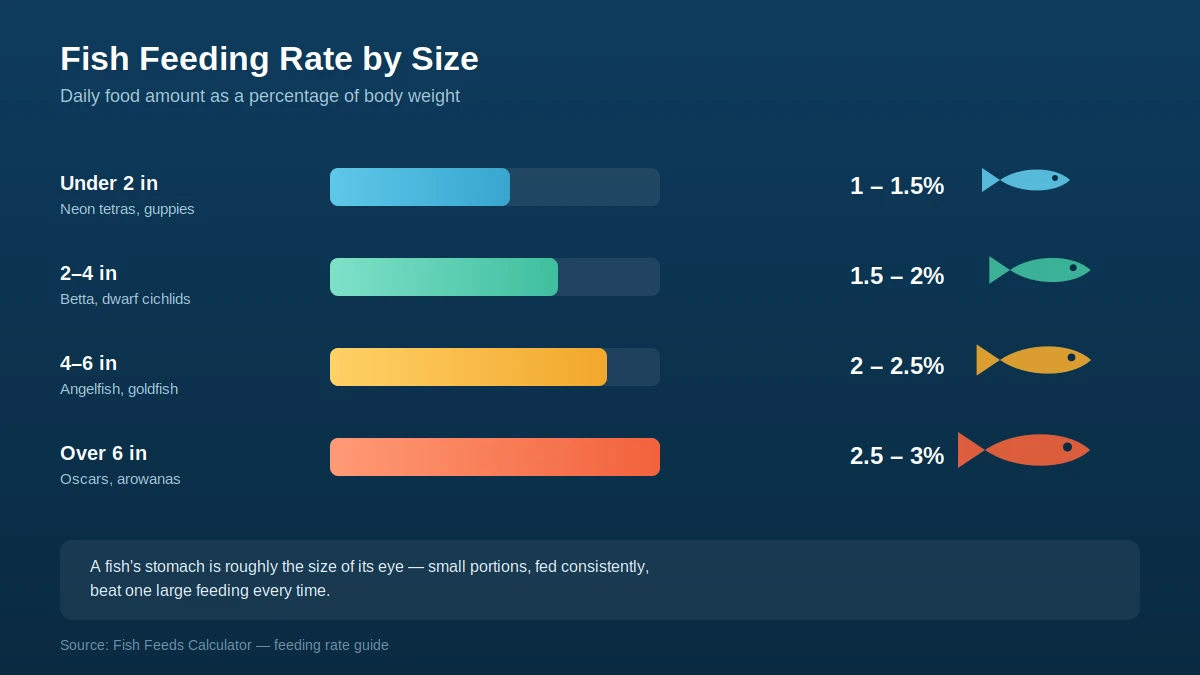
Fish need less food than most people think. A fish's stomach is roughly the size of its eye. That small size means overfeeding happens fast. Most fish thrive on 1 to 2 percent of their body weight each day. Yet the exact amount depends on several factors.
Feeding Rate by Fish Size and Species
Fish size directly affects how much they eat. Smaller fish burn energy faster relative to their body weight. Larger fish eat more in total but less per pound.
Use this table as a starting point:
| Fish Size | Daily Feeding Rate | Example Species |
|---|---|---|
| Under 2 inches | 1 to 1.5 percent of body weight | Neon tetras, guppies |
| 2 to 4 inches | 1.5 to 2 percent of body weight | Betta fish, dwarf cichlids |
| 4 to 6 inches | 2 to 2.5 percent of body weight | Angelfish, goldfish |
| Over 6 inches | 2.5 to 3 percent of body weight | Oscars, arowanas |
Species matters too. Goldfish have long digestive tracts and process food slowly. Bettas need high-protein meals. Cichlids vary widely depending on whether they're herbivores or carnivores. Know your species before setting portions.
Signs of Overfeeding and Underfeeding
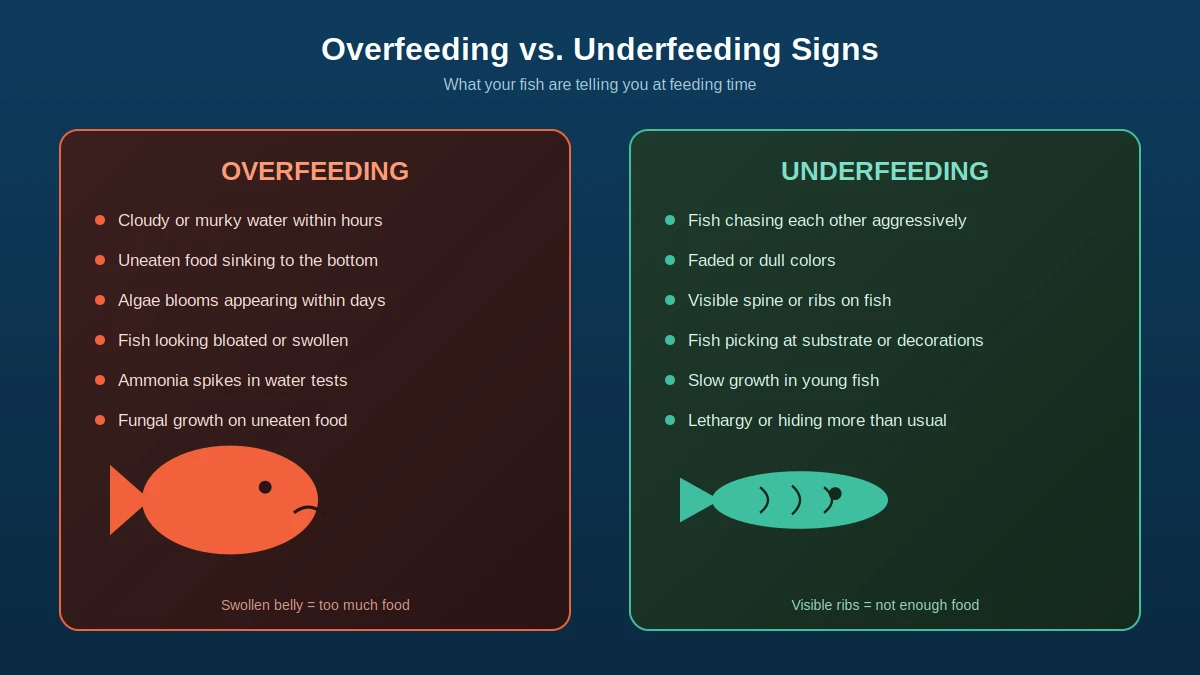
Your fish tell you when feeding is off. You just need to know what to look for.
Overfeeding signs include:
- Cloudy or murky water within hours of feeding
- Uneaten food sinking to the bottom
- Algae blooms appearing within days
- Fish looking bloated or swollen
- Ammonia spikes in water tests
- Fungal growth on uneaten food
Underfeeding signs include:
- Fish chasing each other aggressively
- Faded or dull colors
- Visible spine or ribs on fish
- Fish picking at substrate or decorations
- Slow growth in young fish
- Lethargy or hiding more than usual
Check your fish during every feeding. Adjust portions based on what you see.
What Do Fish Eat
Fish eat a wide range of foods depending on where they come from. Wild fish hunt insects, graze on algae, and eat smaller creatures. Aquarium fish need balanced nutrition that mimics this natural variety. Quality food keeps fish active, colorful, and disease-resistant.
Natural Diet vs. Food for Fish in Aquarium
In the wild, fish spend hours searching for food. They eat what's available in their habitat. River fish eat insects, worms, and plant matter. Reef fish nibble on coral, crustaceans, and small organisms.
Aquarium fish depend on us for every meal. Commercial fish foods are formulated to provide complete nutrition in each bite. They contain proteins, fats, vitamins, and minerals in balanced ratios. Still, supplementing with natural foods boosts health.
Here's how natural and commercial foods compare:
| Factor | Natural Diet | Commercial Food |
|---|---|---|
| Nutrition | Variable based on availability | Consistent and balanced |
| Convenience | Requires live cultures or sourcing | Ready to use |
| Cost | Higher over time | Lower per feeding |
| Enrichment | Triggers natural behaviors | Less stimulating |
| Risk | May carry parasites | Generally safe |
Mix both approaches for the best results. Use commercial food as the base diet. Add live or frozen treats a few times each week.
What Do Small Fish and Fry Eat
Baby fish need special care at mealtime. Their tiny mouths can't handle standard food. Fry grow fast and need frequent, nutrient-dense meals.
First week of life:
- Infusoria (microscopic organisms)
- Liquid fry food
- Hard-boiled egg yolk pressed through cloth
Weeks 2 to 4:
- Newly hatched brine shrimp
- Micro worms
- Crushed flake food
After 4 weeks:
- Baby brine shrimp
- Fine pellet food
- Small live foods like daphnia
Feed fry 3 to 4 times daily. Give only what they finish in 2 minutes. Uneaten food fouls the water fast in fry tanks.
Kinds of Fish Food
Fish food comes in several forms. Each type has strengths and weaknesses. The right choice depends on your fish species, their feeding habits, and your tank setup.
Flake Food
Flake food is the most popular option for home aquariums. It floats on the surface, making it ideal for top-feeding fish. Flakes work well in community tanks with mixed species.
Pros of flake food:
- Affordable and widely available
- Easy to portion for small fish
- Comes in many formulas for different species
- Stores well when kept dry
Cons of flake food:
- Breaks down quickly in water
- Can cloud the tank if overused
- Loses nutrients once the package opens
- Hard to target-feed specific fish
Crush flakes into smaller pieces for fish under 1 inch. Use only what fish eat in 2 minutes.
Pellet Food
Pellets pack more nutrition into each piece than flakes. They come in floating and sinking varieties. Bottom-feeders like catfish and loaches need sinking pellets. Surface feeders prefer floating ones.
Pellet sizes range from 0.5 millimeters for small fish to 10 millimeters for large species. Match pellet size to your fish's mouth. A pellet too large gets spit out or causes choking.
Pellets create less waste than flakes because they hold their shape longer in water. This means cleaner tanks and less filter maintenance.
Live and Frozen Food
Live food brings out natural hunting behaviors in fish. Watching a betta chase live brine shrimp is one of the best parts of fishkeeping.
Popular live foods:
- Bloodworms (larvae of midge flies)
- Brine shrimp (small crustaceans)
- Daphnia (water fleas)
- Tubifex worms
- White worms
Frozen food offers the same nutrition without parasite risks. Most pet stores carry frozen bloodworms, brine shrimp, and mysis shrimp in pre-portioned cubes.
Thaw frozen food in a cup of tank water before adding it to the aquarium. Never drop frozen cubes directly into the tank. The cold can shock your fish.
Offer live or frozen food 2 to 3 times per week as treats. Don't replace the base diet entirely with these options.
Specialty Diets by Species (Herbivore, Carnivore, Omnivore)
Fish fall into three dietary categories. Feeding the wrong diet type causes health problems over time.
Herbivores eat plant-based foods. They need lots of fiber and vegetable matter.
- Best foods: algae wafers, spirulina flakes, blanched vegetables
- Common species: plecos, silver dollars, mbuna cichlids
- Feeding tip: Keep food available throughout the day since herbivores graze constantly
Carnivores eat meat-based foods high in protein.
- Best foods: bloodworms, shrimp, fish fillets, pellet food with 40 percent or more protein
- Common species: bettas, oscars, arowanas, piranhas
- Feeding tip: Feed once or twice daily since carnivores eat larger meals less often
Omnivores eat both plants and animals. Most aquarium fish fall into this category.
- Best foods: quality flake food, pellets, occasional live or frozen treats, vegetable supplements
- Common species: tetras, guppies, mollies, goldfish, corydoras
- Feeding tip: Rotate between protein and plant-based foods for balanced nutrition
How to Feed Fish the Right Way
Good feeding habits go beyond choosing the right food. How you feed matters just as much. Consistency, timing, and observation make the difference between thriving fish and struggling ones.
How Often to Feed Fish
Most adult fish do well with 2 feedings per day. Young, growing fish need 3 to 4 smaller meals. Some species, like goldfish, thrive on just 1 feeding daily.
Follow these general rules:
- Feed adult fish twice daily, once in the morning and once in the evening.
- Give only what fish finish in 2 to 3 minutes.
- Skip feeding 1 day per week to let fish digest fully.
- Increase frequency for fry and juvenile fish.
- Reduce feeding during cold months when metabolism slows.
Overfeeding happens more often than underfeeding. When in doubt, feed less.
Best Time of Day to Feed Fish
Morning feeding works best for most fish. Fish are active and hungry after resting overnight. Their metabolism peaks during daylight hours.
Feeding schedule by fish type:
| Fish Type | Best Feeding Time | Reason |
|---|---|---|
| Diurnal (daytime active) | Morning and early evening | Matches natural activity patterns |
| Nocturnal (nighttime active) | Evening or just before lights out | Aligns with their wake cycle |
| Fry and juveniles | Spread throughout the day | Supports rapid growth needs |
Keep the schedule consistent. Fish learn when to expect food. Sudden changes stress them out.
Feeding Fish While Away or on Vacation
Leaving fish for a few days doesn't have to be stressful. With the right plan, your fish stay fed and healthy.
For trips of 1 to 3 days:
- Most healthy adult fish can go without food for 48 to 72 hours
- Do a large water change before leaving
- Don't add extra food before you go. It just fouls the water
For trips of 4 to 7 days:
- Use a weekend feeder block that dissolves slowly
- Set up an automatic fish feeder with pre-portioned daily amounts
- Test the feeder for 2 days before your trip to make sure it works
For trips longer than 7 days:
- Ask a trusted friend or neighbor to feed your fish
- Pre-portion food into labeled daily bags
- Write clear instructions: how much, how often, and what not to do
- Show them the correct portion size in person
Automatic feeders range from $10 to $40 and work well for most setups. Load them with dry food only. Frozen or live food doesn't work in automatic feeders.
Common Fish Feeding Mistakes to Avoid
Even experienced fishkeepers make feeding errors. Knowing these mistakes helps you avoid them.
Mistake 1: Feeding too much at once
This is the number one problem. Excess food sinks, rots, and spikes ammonia. Fish look hungry even after eating enough. Their instinct is to keep eating whenever food appears. You control the portions, not them.
Mistake 2: Using only one food type
Flakes alone don't provide complete nutrition over time. Rotate between flakes, pellets, frozen food, and fresh vegetables. Variety prevents nutritional gaps.
Mistake 3: Ignoring expiration dates
Fish food loses vitamins within 3 months of opening. Old food may grow mold or bacteria. Buy smaller containers and use them within 60 to 90 days. Store food in a cool, dry place away from sunlight.
Mistake 4: Not matching food to species
Herbivores fed only protein-rich foods develop digestive problems. Carnivores fed only plant-based food become malnourished. Know what your fish eat in the wild and replicate that as closely as possible.
Mistake 5: Dropping food into dirty water
Feed only after checking water clarity. If the water looks cloudy, skip that feeding. Clean the tank first, then resume the normal schedule.
Mistake 6: Not observing during feeding
Watch your fish eat every time. Notice which ones eat and which hang back. Aggressive fish may hog food while shy fish starve. Adjust feeding spots or add more feeding points to solve this.
Quick reference checklist:
- Feed only what fish eat in 2 to 3 minutes
- Remove uneaten food after 5 minutes
- Change 25 percent of the water weekly
- Test water parameters monthly
- Rotate food types throughout the week
- Replace fish food every 3 months
Using a Fish Feeds Calculator removes the guesswork from this whole process. It gives you exact amounts tailored to your specific fish, their size, and your tank conditions. Pair it with the right food types, a consistent schedule, and regular observation. Your fish will reward you with bright colors, active behavior, and long, healthy lives. Feed smart, not more.
How much to feed and how often: top species, in detail
The summary above covers the quick version. For the species we get asked about most, here's the fuller answer:
- How much to feed a betta fish: 3–4 pellets, twice daily, with one fast day weekly. See our full betta feeding guide for portion sizes by pellet brand and signs you're overdoing it.
- How often to feed goldfish: Twice daily, sinking pellets, with a weekly blanched-pea day to prevent swim-bladder issues. See what to feed goldfish at home for a full breakdown.
- How much to feed neon tetras: A pinch of micro-pellets or crushed flake twice daily, consumed within 60 seconds — oversized portions are the main cause of neon tetra bloat. Run the numbers for your group size with our neon tetra stocking guide.
- How much to feed guppies: Small pinch of flake or micro-pellet, twice daily; guppies graze constantly so slight underfeeding is safer than overfeeding.
- How often to feed cherry shrimp: A tiny pinch every 2–3 days — see our cherry shrimp feeding guide for the full schedule and food list.
Complete species feeding directory — all 28 fish, shrimp & snail species
Every species built into the calculator above, with its diet type, adult and juvenile feeding schedule, recommended foods, foods to avoid, and fasting guidance. Click a species to expand.
Freshwater species
Betta (Siamese fighting fish) (Betta splendens)
- Category
- Freshwater
- Diet type
- Carnivore
- Adult feeding
- 2x daily, 3-4 pellets per feeding (6-8 pellets/day total)
- Juvenile feeding
- 3x daily, 2-3 pellets per feeding (6-9 pellets/day total)
- Weekly fast day recommended
- Yes — benefits from one fasting day per week.
Recommended foods (priority order):
- High-protein betta pellets
- Frozen bloodworms (2x/week)
- Frozen brine shrimp
- Live blackworms (treat)
Avoid:
- Generic tropical flakes
- Dried bloodworms (cause bloat)
Bettas are surface feeders with small stomachs. One day of fasting per week prevents constipation, a leading cause of swim-bladder issues.
Guppy (Poecilia reticulata)
- Category
- Freshwater
- Diet type
- Omnivore
- Adult feeding
- 2x daily, a pinch of flakes eaten within 30 seconds
- Juvenile feeding
- 3x daily, crushed flakes in small frequent feeds
- Weekly fast day recommended
- Not required for this species.
Recommended foods (priority order):
- Quality tropical flakes
- Crushed pellets
- Frozen daphnia
- Spirulina flakes (1x/week)
Avoid:
- Large pellets (mouth too small)
Continuous feeders that benefit from small, varied meals. Include vegetable matter (spirulina) to prevent constipation in fancy strains.
Molly (Poecilia sphenops (species complex))
- Category
- Freshwater
- Diet type
- Omnivore
- Adult feeding
- 2x daily, a generous pinch, 60-second rule
- Juvenile feeding
- 3x daily, crushed flakes in small frequent feeds
- Weekly fast day recommended
- Not required for this species.
Recommended foods (priority order):
- Vegetable flakes
- Spirulina pellets
- Blanched spinach/courgette
- Frozen daphnia
Avoid:
- Pure protein diets (cause bloat)
Mollies are heavy on vegetable matter — at least 60% of diet should be plant-based. Algae grazing is natural and beneficial.
Platy (Xiphophorus maculatus)
- Category
- Freshwater
- Diet type
- Omnivore
- Adult feeding
- 2x daily, a pinch of flakes, 30-second rule
- Juvenile feeding
- 3x daily, crushed flakes in small frequent feeds
- Weekly fast day recommended
- Not required for this species.
Recommended foods (priority order):
- Tropical community flakes
- Spirulina flakes
- Frozen brine shrimp
- Blanched vegetables
Avoid:
- No major foods to avoid for this species.
Hardy and undemanding. Vary diet between protein and vegetable matter for best colour development.
Neon Tetra (Paracheirodon innesi)
- Category
- Freshwater
- Diet type
- Omnivore
- Adult feeding
- 2x daily, a small pinch consumed in 20-30 seconds
- Juvenile feeding
- 3x daily, crushed flakes in tiny meals
- Weekly fast day recommended
- Not required for this species.
Recommended foods (priority order):
- Crushed tropical flakes
- Micro-pellets
- Frozen daphnia
- Frozen cyclops
Avoid:
- Large pellets
- Bloodworms in excess
Mid-water feeders with small mouths. Food should sink slowly through the water column; sinking pellets get ignored.
Cardinal Tetra (Paracheirodon axelrodi)
- Category
- Freshwater
- Diet type
- Omnivore
- Adult feeding
- 2x daily, a small pinch consumed in 20-30 seconds
- Juvenile feeding
- 3x daily, crushed flakes in tiny meals
- Weekly fast day recommended
- Not required for this species.
Recommended foods (priority order):
- Crushed tropical flakes
- Micro-pellets
- Frozen baby brine shrimp
- Frozen daphnia
Avoid:
- Large food items
Slightly more carnivorous than neons. Live or frozen baby brine shrimp brings out the best red colouration.
Corydoras Catfish (Corydoras spp.)
- Category
- Freshwater
- Diet type
- Omnivore
- Adult feeding
- 1x daily (evening), 1-2 sinking wafers
- Juvenile feeding
- 2x daily, crushed wafers in small frequent meals
- Weekly fast day recommended
- Yes — benefits from one fasting day per week.
Recommended foods (priority order):
- Sinking catfish pellets
- Algae wafers
- Frozen bloodworms
- Live blackworms (treat)
Avoid:
- Surface-only foods (they will starve)
Bottom feeders that need food reaching the substrate. Feed after lights-out so other fish don't steal their share. Not just "cleanup crew" — they need dedicated meals.
Bristlenose Plec (Ancistrus spp.)
- Category
- Freshwater
- Diet type
- Herbivore
- Adult feeding
- 1x daily (evening), 1-2 algae wafers
- Juvenile feeding
- 2x daily, half a wafer per feeding
- Weekly fast day recommended
- Not required for this species.
Recommended foods (priority order):
- Algae wafers
- Blanched courgette
- Blanched cucumber
- Driftwood (essential for digestion)
Avoid:
- Heavy protein diet (causes liver damage)
85% of diet should be plant matter. Provide a piece of driftwood permanently — bristlenoses need to rasp wood for digestion.
Angelfish (Pterophyllum scalare)
- Category
- Freshwater
- Diet type
- Omnivore
- Adult feeding
- 2x daily, 5-7 pellets per feeding (10-14 pellets/day)
- Juvenile feeding
- 3x daily, 3-4 pellets per feeding (9-12 pellets/day)
- Weekly fast day recommended
- Yes — benefits from one fasting day per week.
Recommended foods (priority order):
- Cichlid pellets
- Frozen bloodworms
- Frozen brine shrimp
- High-quality flakes
Avoid:
- Tubifex worms (disease risk)
Adults are slightly carnivorous. Vary diet to maintain pair-bonding and breeding readiness. Stop feeding 24h before water changes.
Discus (Symphysodon spp.)
- Category
- Freshwater
- Diet type
- Carnivore
- Adult feeding
- 3x daily, a beef-heart cube or equivalent, spread through the day
- Juvenile feeding
- 5x daily, small portions spread continuously through the day
- Weekly fast day recommended
- Yes — benefits from one fasting day per week.
Recommended foods (priority order):
- Beef-heart mix (homemade)
- Frozen bloodworms
- Discus-specific pellets
- Live blackworms
Avoid:
- Mammal meat in excess (digestion issues)
- Tubifex (disease)
Heavy feeders that demand water-change rigour: 30-50% changes daily for juveniles, 2-3x weekly for adults. Mistreatment shows in stunted growth.
Goldfish (Fancy varieties) (Carassius auratus)
- Category
- Freshwater
- Diet type
- Omnivore
- Adult feeding
- 2x daily, 2 minutes worth, no leftover food
- Juvenile feeding
- 3x daily, 90 seconds worth, no leftovers
- Weekly fast day recommended
- Yes — benefits from one fasting day per week.
Recommended foods (priority order):
- Sinking goldfish pellets
- Blanched peas (deshelled)
- Gel food
- Spirulina
Avoid:
- Floating pellets (gulp air, swim-bladder issues)
- Bread
Sinking pellets only — fancy goldfish swallow air with floating food and develop chronic swim-bladder problems. Weekly pea day prevents constipation.
Goldfish (Common/Comet) (Carassius auratus)
- Category
- Freshwater
- Diet type
- Omnivore
- Adult feeding
- 2x daily, 2-3 minutes worth, a generous feed
- Juvenile feeding
- 3x daily, 90 seconds worth, smaller meals
- Weekly fast day recommended
- Yes — benefits from one fasting day per week.
Recommended foods (priority order):
- Goldfish pellets
- Blanched lettuce
- Live daphnia
- Earthworms (chopped)
Avoid:
- Tropical fish food (wrong nutrient balance)
These grow into pond fish (30+ cm). Feed accordingly — and consider a pond setup when they outgrow the indoor tank.
Oscar (Astronotus ocellatus)
- Category
- Freshwater
- Diet type
- Carnivore
- Adult feeding
- 1x daily, 4-6 large pellets or equivalent, one large meal
- Juvenile feeding
- 2x daily, 3-4 pellets per feeding
- Weekly fast day recommended
- Yes — benefits from one fasting day per week.
Recommended foods (priority order):
- Large cichlid pellets
- Frozen krill
- Frozen prawns (chopped)
- Earthworms
Avoid:
- Live feeder fish (disease + nutritionally poor)
- Mammal meat
Stop feeding live feeder goldfish — they introduce disease and thiaminase damages oscar liver. Quality pellet base plus varied frozen food.
Apistogramma (Dwarf Cichlid) (Apistogramma spp.)
- Category
- Freshwater
- Diet type
- Carnivore
- Adult feeding
- 2x daily, small portion, 60-second rule
- Juvenile feeding
- 3x daily, tiny portions spread through the day
- Weekly fast day recommended
- Not required for this species.
Recommended foods (priority order):
- Frozen baby brine shrimp
- Frozen bloodworms
- Sinking micro-pellets
- Live grindal worms
Avoid:
- Large flake food
Strongly prefer live or frozen food. Pellets accepted but enthusiasm matters — well-fed apistos colour up dramatically.
Rasbora (Harlequin/Chili) (Trigonostigma heteromorpha / Boraras brigittae)
- Category
- Freshwater
- Diet type
- Omnivore
- Adult feeding
- 2x daily, small pinch consumed in 20-30 seconds
- Juvenile feeding
- 3x daily, crushed flakes in tiny meals
- Weekly fast day recommended
- Not required for this species.
Recommended foods (priority order):
- Crushed flakes
- Micro-pellets
- Frozen daphnia
- Frozen cyclops
Avoid:
- Large pellets
Tiny mouths require small particles. Slow-sinking food works best — they feed in the upper to mid water column.
Zebra Danio (Danio rerio)
- Category
- Freshwater
- Diet type
- Omnivore
- Adult feeding
- 2x daily, a pinch of flakes, 30-second rule
- Juvenile feeding
- 3x daily, crushed flakes in smaller meals
- Weekly fast day recommended
- Not required for this species.
Recommended foods (priority order):
- Tropical flakes
- Micro-pellets
- Frozen daphnia
- Frozen brine shrimp
Avoid:
- No major foods to avoid for this species.
Voracious surface feeders. Will outcompete slower tankmates — feed in two locations to ensure others get fed.
Gourami (Honey/Dwarf/Pearl) (Trichogaster spp. / Trichopsis spp.)
- Category
- Freshwater
- Diet type
- Omnivore
- Adult feeding
- 2x daily, 4-6 pellets per feeding (8-12 pellets/day)
- Juvenile feeding
- 3x daily, 3-4 pellets per feeding (9-12 pellets/day)
- Weekly fast day recommended
- Not required for this species.
Recommended foods (priority order):
- Tropical flakes
- Micro/medium pellets
- Frozen bloodworms
- Spirulina flakes
Avoid:
- No major foods to avoid for this species.
Anabantoids — they breathe surface air. Floating pellets work well. Vary protein and vegetable matter for best colour.
Killifish (Various genera (e.g. Nothobranchius, Aphyosemion))
- Category
- Freshwater
- Diet type
- Carnivore
- Adult feeding
- 2x daily, small portion, 60-second rule
- Juvenile feeding
- 3x daily, tiny portions spread through the day
- Weekly fast day recommended
- Not required for this species.
Recommended foods (priority order):
- Live blackworms
- Frozen daphnia
- Frozen baby brine shrimp
- Carnivore micro-pellets
Avoid:
- Pure flake diet
Strong preference for live or frozen food. Many species refuse dry food entirely — research your specific killifish species before purchase.
Cherry/Crystal Shrimp (Neocaridina davidi / Caridina cantonensis)
- Category
- Freshwater
- Diet type
- Omnivore
- Adult feeding
- Every 2-3 days, a tiny pinch — less is more
- Juvenile feeding
- Every 2-3 days, a tiny pinch — mostly biofilm
- Weekly fast day recommended
- Yes — benefits from one fasting day per week.
Recommended foods (priority order):
- Shrimp-specific pellets
- Blanched spinach (1x/week)
- Indian almond leaves
- Mulberry leaves
Avoid:
- Copper-containing fish food
- Anything labeled with copper sulphate
Most shrimp deaths are from overfeeding, not underfeeding. They graze biofilm constantly — supplemental food only every 2-3 days.
Mystery/Nerite Snail (Pomacea bridgesii / Neritina spp.)
- Category
- Freshwater
- Diet type
- Herbivore
- Adult feeding
- Every 2-3 days, an algae wafer — mostly grazes algae
- Juvenile feeding
- Every 2-3 days, an algae wafer — mostly biofilm
- Weekly fast day recommended
- Yes — benefits from one fasting day per week.
Recommended foods (priority order):
- Algae wafers
- Blanched courgette
- Blanched spinach
- Calcium supplement (cuttlebone)
Avoid:
- Copper-containing food
Snails graze constantly on biofilm and algae. Supplement with vegetables only if the tank is too clean. Calcium is essential for shell health.
Marine species
Clownfish (Amphiprion ocellaris)
- Category
- Marine
- Diet type
- Omnivore
- Adult feeding
- 2x daily, 5-7 pellets per feeding (10-14 pellets/day)
- Juvenile feeding
- 3x daily, 3-4 pellets per feeding (9-12 pellets/day)
- Weekly fast day recommended
- Not required for this species.
Recommended foods (priority order):
- Marine pellets
- Frozen mysis shrimp
- Frozen brine shrimp (gut-loaded)
- Marine flakes
Avoid:
- Freshwater-formulated food
Hardy and adaptable. Mysis shrimp is the staple — soak briefly in a vitamin supplement (Selcon, VitaChem) once per week.
Yellow/Blue Tang (Zebrasoma flavescens / Paracanthurus hepatus)
- Category
- Marine
- Diet type
- Herbivore
- Adult feeding
- 2x daily, a sheet of nori plus pellet, continuous grazing
- Juvenile feeding
- 3x daily, smaller portions, continuous grazing
- Weekly fast day recommended
- Not required for this species.
Recommended foods (priority order):
- Nori sheets (clipped)
- Marine algae flakes
- Spirulina pellets
- Mysis shrimp (1x/week)
Avoid:
- Pure carnivore diet (causes lateral line erosion)
Tangs need to graze almost continuously. A nori clip should be present in the tank most of the day. Lateral line erosion is the #1 sign of dietary failure.
Watchman/Yellow Goby (Cryptocentrus cinctus (and related genera))
- Category
- Marine
- Diet type
- Carnivore
- Adult feeding
- 2x daily, small portion, 60-second rule
- Juvenile feeding
- 3x daily, tiny portions spread through the day
- Weekly fast day recommended
- Not required for this species.
Recommended foods (priority order):
- Frozen mysis
- Frozen brine shrimp
- Marine pellets (small)
- Live copepods (treat)
Avoid:
- No major foods to avoid for this species.
Bottom feeders with small mouths. Sinking food works best. Pair with pistol shrimp for natural symbiosis and entertainment.
Sixline/Fairy Wrasse (Pseudocheilinus hexataenia / Cirrhilabrus spp.)
- Category
- Marine
- Diet type
- Carnivore
- Adult feeding
- 2x daily, 5-7 pellets per feeding (10-14 pellets/day)
- Juvenile feeding
- 3x daily, 3-4 pellets per feeding (9-12 pellets/day)
- Weekly fast day recommended
- Not required for this species.
Recommended foods (priority order):
- Marine pellets
- Frozen mysis
- Frozen Hikari brine
- Live pods
Avoid:
- No major foods to avoid for this species.
Active swimmers with high metabolism. Need 2-3 feedings daily. Hide and sleep early, so feed before lights-out.
Banggai/Pyjama Cardinalfish (Pterapogon kauderni / Sphaeramia nematoptera)
- Category
- Marine
- Diet type
- Carnivore
- Adult feeding
- 2x daily, small portion, 60-second rule
- Juvenile feeding
- 3x daily, smaller portions spread through the day
- Weekly fast day recommended
- Not required for this species.
Recommended foods (priority order):
- Frozen mysis
- Frozen brine shrimp
- Small marine pellets
- Live brine
Avoid:
- Pure flake diet
Slow, deliberate feeders. May be outcompeted by faster tankmates — target-feed with a turkey baster if needed.
Lyretail Anthias (Pseudanthias squamipinnis)
- Category
- Marine
- Diet type
- Carnivore
- Adult feeding
- 4x daily, small portions, frequent small meals
- Juvenile feeding
- 5x daily, tiny portions, almost continuous
- Weekly fast day recommended
- Not required for this species.
Recommended foods (priority order):
- Frozen mysis
- Frozen calanus
- Frozen cyclops
- Live copepods
Avoid:
- Once-daily feeding (will starve)
Demand 3-4 feedings per day minimum — adapted to constant zooplankton grazing on reefs. Auto-feeders strongly recommended.
Damselfish (Family Pomacentridae (e.g. Dascyllus, Chromis))
- Category
- Marine
- Diet type
- Omnivore
- Adult feeding
- 2x daily, small pinch, 30-second rule
- Juvenile feeding
- 3x daily, smaller pinches, smaller meals
- Weekly fast day recommended
- Not required for this species.
Recommended foods (priority order):
- Marine flakes
- Marine pellets
- Frozen mysis
- Spirulina flakes
Avoid:
- No major foods to avoid for this species.
Hardy and aggressive eaters. Will dominate feeding time — ensure shyer tankmates also get fed.
Lawnmower/Tailspot Blenny (Salarias fasciatus / Ecsenius stigmatura)
- Category
- Marine
- Diet type
- Herbivore
- Adult feeding
- 2x daily, small portion plus nori, continuous grazing
- Juvenile feeding
- 3x daily, smaller portions, continuous grazing
- Weekly fast day recommended
- Not required for this species.
Recommended foods (priority order):
- Nori sheets
- Marine algae flakes
- Spirulina pellets
- Algae from rocks
Avoid:
- Pure protein diet
Algae grazers — only thrive in tanks with established algae growth. New tanks lacking algae require daily nori supplementation.
FAQs
Is it bad to overfeed fish?
Yeah, honestly it's one of the most common mistakes we see people make. Fish don't really have an "I'm full" switch way do, so they'll just keep eating whatever you drop in. The problem isn't much fish getting fat — everything that sinks to bottom uneaten. That leftover food rots, ammonia spikes, and suddenly you're dealing with cloudy water or a sick tank for reasons seemed totally unrelated feeding. If you've ever run your numbers through our Feed Calculator still felt unsure, good gut check is watching how fast they clear if there's stuff sitting on substrate after few minutes, giving too much.
Can I feed all fish in a community tank the same food?
You can, but it's not really the best move if you want everyone thriving. A community tank usually has a mix of feeding styles — some fish hang out at top and grab flakes, others are bottom dwellers who need sinking pellets, few might be picky about protein content. Tossing in one type food across board means somebody's missing out. We'd say pick solid staple for majority, then supplement with something targeted outliers like wafer your catfish or algae eaters.
How do I know if my fish are hungry or full?
Fish are actually pretty easy to read once you know what look for. Hungry fish tend gather near the surface or feeding spot moment walk tank — they get a little frantic. A full fish, on other hand, loses interest fast, drifts away from food, just stops chasing it mid-meal. The two-to-three-minute rule works well here if they're still eagerly going for food after that window, were probably hungry. If food's floating untouched, already satisfied.
How long can fish survive without food?
Longer than most people assume, honestly. Healthy adult fish can typically go anywhere from a week to two weeks without eating and be totally fine their metabolism just slows down. That said, it depends lot on species age. Fry juveniles burn through energy way faster can't skip meals nearly as long. So if you're heading out of town for weekend, don't stress about your starving the bigger risk is usually someone overfeeding them "just in case" before leaving, which causes more harm trip itself.
What happens if I underfeed my fish?
It's less dramatic than overfeeding in terms of water quality, but it's still not great. Underfed fish tend to grow slower, lose color vibrancy, and can become more aggressive toward tankmates — especially species that get territorial when food's scarce. Over time you might also notice weaker immune response, since need consistent nutrition fight off the usual stuff like fin rot or parasites. If you're consistently guessing on portions, running your setup through our Fish Feed Calculator once save from years under- over-correcting by feel.
Do different fish species need different feeding schedules?
Definitely, and this is honestly where a lot of people go wrong without realizing it. Some fish, like bettas, do fine with one feeding day. Others, especially smaller or more active schooling species, actually better two three lighter feedings spread out. Bottom feeders often need slightly different rhythm too, since they're scavenging leftover food others miss. It's less about universal rule matching frequency to how that specific species eats in the wild — grazers versus opportunistic behave really differently at mealtime.
Need to size your tank first?
Run your aquarium dimensions through our volume calculator to get accurate water capacity, then come back and feed accordingly.
Volume calculator