
The first time I saw a genuine Nature Aquarium layout, in photos from Takashi Amano's own work, I didn't initially recognize it as an aquarium at all — it looked more like a tiny, submerged mountain valley, complete with what felt like real geological history and distance. That reaction is really the whole point of this style: it isn't trying to look decorated, it's trying to look discovered, as though you've stumbled onto a genuine piece of untouched nature that happens to be underwater.
This guide walks through four core techniques that define Nature Aquarium style, from its distinctive hardscape approach to its deeper philosophy around growth and change over time. Each idea includes a detailed image prompt so you can visualize the finished look before starting your own build.
Where Nature Aquarium Style Comes From
Nature Aquarium style was developed and popularized by Takashi Amano starting in the 1990s, drawing heavily on his background in landscape photography and a deep appreciation for Japanese garden traditions. Unlike more rigid, rule-based styles, Nature Aquarium is fundamentally about recreating the feeling of a specific remembered landscape, using dense planting, layered hardscape, and classical composition principles borrowed from fine art rather than a fixed formula.
1. Layer Stone and Driftwood Into a Real Landscape
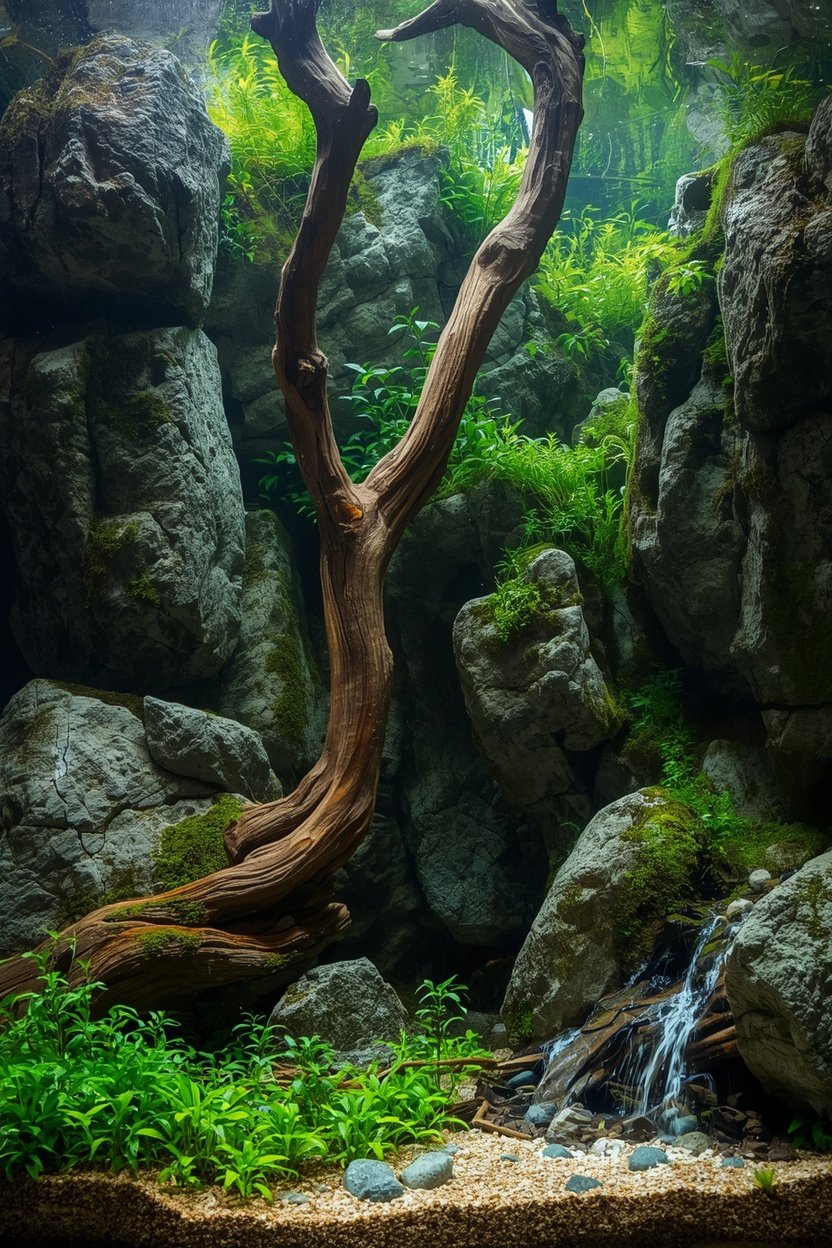
The defining technique of Nature Aquarium style, pioneered by Japanese aquascaper Takashi Amano, is combining stone and driftwood together into a single layered composition that reads as a genuine landscape — a mountain ridge, a forest hillside, a valley floor — rather than placing hardscape as isolated decorative objects. This technique, sometimes called ryoboku when driftwood and stone are bound together, creates a sense of geological and botanical history, as though the wood grew naturally among rocks that were already there.
Build this layered effect by anchoring driftwood directly against or partially beneath larger stones, rather than placing each element in its own separate zone of the tank. The wood should look like it emerged from the landscape, not like it was dropped on top of it afterward, which usually means working the base of each branch into or against the stone rather than resting it loosely alongside.
This combined hardscape approach is what most distinguishes Nature Aquarium style from simpler rock-only layouts like Iwagumi — it's explicitly trying to recreate an entire remembered landscape, using both materials working together, rather than exploring stone placement as its own isolated discipline.
2. Build Dense Planting With a Natural Height Gradient
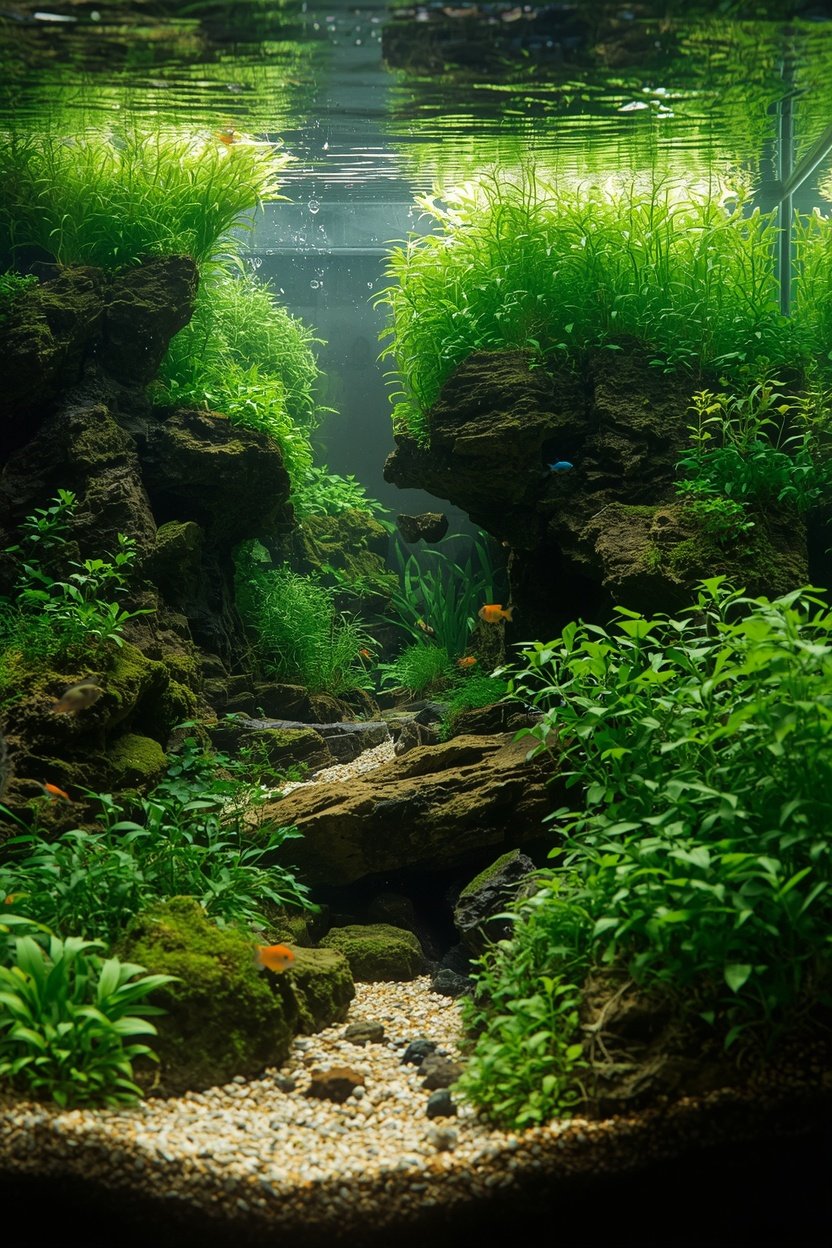
Where Iwagumi often uses a single low carpet plant to stay minimal, Nature Aquarium style embraces fuller, more varied planting, gradually increasing in height from a low foreground carpet through mid-ground stem plants to taller background growth, mimicking how real landscapes transition from meadow to forest. This gradient is what gives a Nature Aquarium its characteristic sense of depth and distance within a relatively shallow tank.
Select a range of plant heights and leaf textures deliberately, rather than letting growth happen randomly, and trim consistently to maintain the gradient's shape as everything matures. Fine-textured plants like dwarf hairgrass in the foreground, contrasted against broader-leafed stem plants further back, reinforce the sense of perspective the whole technique depends on.
This dense, gradient-based planting approach requires considerably more ongoing maintenance than a sparser style, with regular trimming needed to prevent faster-growing background plants from overtaking the composition's carefully built sense of scale and distance.

3. Place the Focal Point Using the Golden Ratio
Amano frequently drew on classical composition principles from painting and photography, most notably the golden ratio, positioning a tank's main focal stone or branch at one of the composition's natural points of visual interest rather than centering it or placing it arbitrarily. This mathematical approach to placement is part of why Nature Aquarium layouts often feel so immediately balanced and intentional, even to viewers with no aquascaping background.
In practice, this means positioning your tank's dominant hardscape element roughly a third to two-fifths of the way across the tank's width, rather than dead center or at a random point. This placement echoes the same principle used in photography and classical painting, where off-center focal points tend to feel more dynamic and natural than perfectly centered ones.
While exact golden ratio measurements aren't strictly necessary for a beginner to calculate, understanding the underlying principle — asymmetry over symmetry, considered placement over arbitrary placement — is one of the most transferable lessons from Nature Aquarium style into any other aquascaping approach you might try afterward.

4. Embrace Growth, Change, and Eventual Renewal
Perhaps the most philosophically distinct part of Nature Aquarium style is its relationship with time: rather than treating a finished layout as a permanent, static display, Amano's approach embraced the idea that a tank is a living thing that grows, changes, and eventually needs to be broken down and rebuilt, mirroring nature's own cycles of growth and renewal. A Nature Aquarium is never really "finished" in the way a static piece of furniture is.
In practice, this means planning your hardscape and plant choices with their future growth in mind from the very beginning, rather than judging the tank purely by how it looks on day one. A layout that looks a little sparse at first often reaches its true intended form only after several months of plant growth and trimming shape it into the final vision.
Eventually, many dedicated Nature Aquarium hobbyists do fully tear down and rebuild even a successful, mature tank, treating the process as a natural part of the hobby's ongoing creative cycle rather than a failure or a waste. Approaching your own tank with this same mindset — expecting change, planning for growth, and accepting eventual renewal — is arguably the most authentic way to practice Nature Aquarium style, beyond any single technique.
Tips for Starting Your First Nature Aquarium
- Study real landscape photography for inspiration. Amano himself drew directly from his own nature photography, and doing the same can inform more convincing hardscape placement.
- Invest in strong lighting and CO2 if possible. The dense planting central to this style generally requires more robust lighting and carbon dioxide supplementation than a sparser aquascape.
- Be patient with the growing-in process. A Nature Aquarium layout often looks its best only after several months of plant growth and shaping, not immediately after setup.
- Keep a trimming schedule. Regular, consistent trimming is essential for maintaining the height gradient and overall composition as plants mature.
Final Thoughts
Nature Aquarium style asks more of a hobbyist than many other aquascaping approaches, both in technical skill and in patience, but the reward is a tank that feels like a genuine piece of discovered landscape rather than a decorated display. Layered hardscape, gradient planting, considered composition, and an acceptance of ongoing growth and change together define a style that's as much a philosophy as it is a set of techniques — one well worth exploring even if you never fully commit to it as your primary approach.
Frequently asked questions
Is Nature Aquarium style suitable for beginners?
It's more demanding than simpler styles like Iwagumi, given its reliance on dense planting and strong lighting, but a beginner with patience and willingness to learn plant care can absolutely work toward this style over time.
How is Nature Aquarium different from Iwagumi?
Iwagumi focuses specifically on minimal stone arrangement following strict placement rules, while Nature Aquarium combines stone, driftwood, and denser, more varied planting to recreate an entire landscape scene rather than a single rock-focused composition.
How long does a Nature Aquarium take to fully mature?
Most layouts take at least several months of consistent growth and trimming to reach their intended fuller form, with many hobbyists considering a tank truly mature only after six months to a year of development.
