My first nano tank was a disaster, and looking back, it's obvious why: I decorated it exactly like I would a standard 20-gallon tank, just with smaller versions of the same amount of stuff. A rock here, some driftwood there, a few plants scattered around and the whole thing ended up looking like a cluttered fishbowl rather than the sleek little display I'd pictured. It took starting over from scratch, with a completely different mindset, to actually get a nano tank that looked good.
Nano tanks, generally anything under 5 gallons, reward a very different decorating approach than larger aquariums. Instead of asking "what can I fit in here," the better question is "what's the one thing that will carry this entire tiny space." These three ideas answer that question in three different ways, and each one includes a detailed image prompt so you can preview the look before setting anything up.
Why Nano Tanks Need a Different Decorating Approach
In a large aquarium, several decorations can coexist because there's enough visual space for the eye to process each one separately. In a nano tank, every single object takes up a much bigger share of the total view, so adding several small pieces the way you might in a bigger tank almost always reads as cluttered rather than detailed. The most successful nano tanks lean into restraint, scale, and a single strong idea rather than trying to replicate a full-size aquascape in miniature.
1. Scale Everything Down with Miniature Hardscape
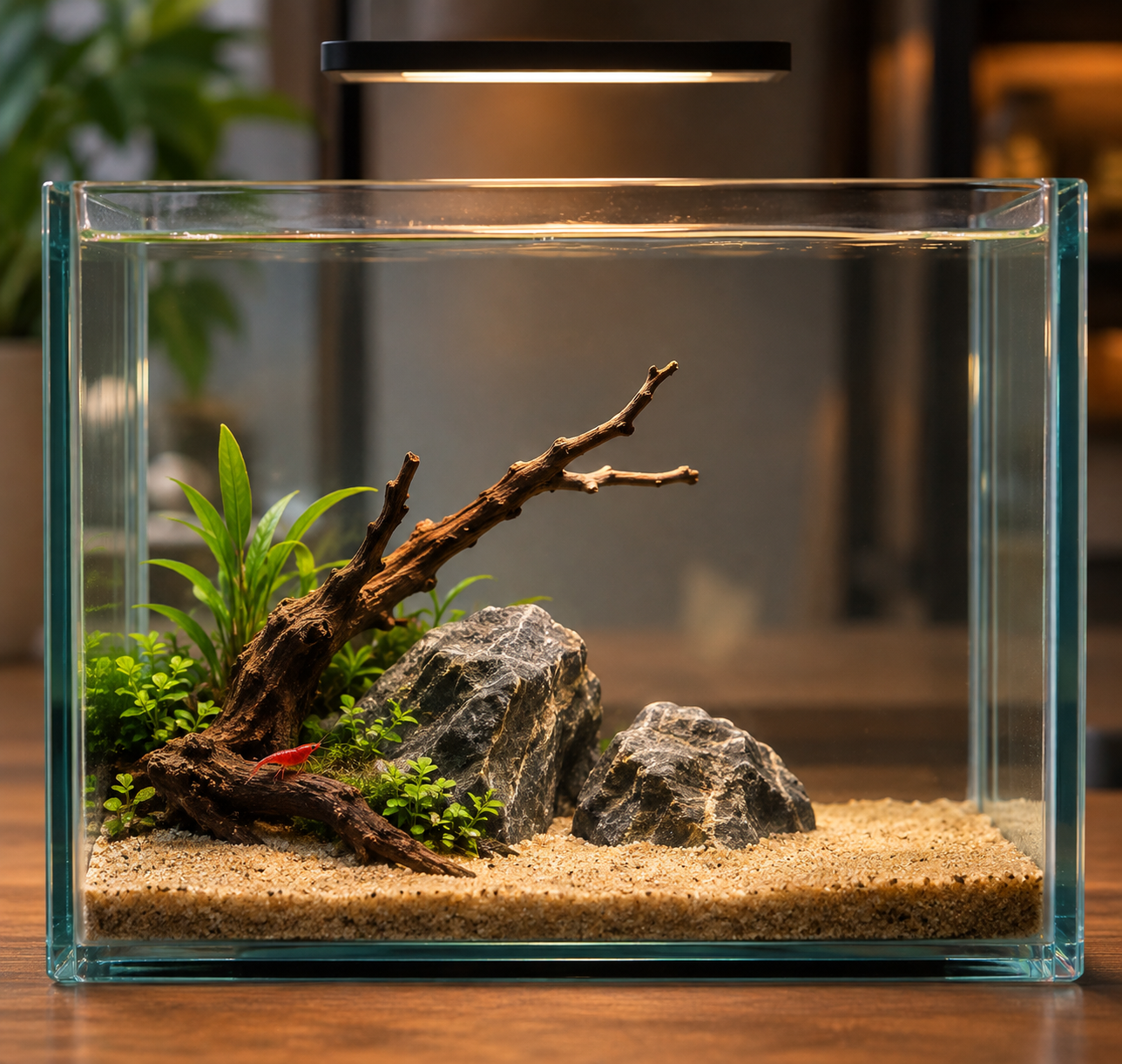
The single biggest decorating mistake in nano tanks is using hardscape sized for a standard 20-gallon aquarium. A rock or driftwood piece that looks modest in a full-size tank can completely overwhelm a 2-to-5-gallon nano tank, leaving no room for fish to swim and making the whole setup feel like a diorama stuffed into too small a box.
Instead, look specifically for "nano-sized" or "aquascaping stones" sold in small, fist-sized pieces rather than the larger landscaping rock often marketed for bigger tanks. The same goes for driftwood thin, spindly branches or small root pieces scale far more naturally to a nano tank than a single thick log that was clearly cut down from a larger piece.
A helpful trick here is to hold any potential piece up next to the actual tank before buying it, rather than judging scale from a product photo. What looks small on a store shelf next to dozens of other items can look surprisingly large once it's the only object inside a few liters of water. Aim for hardscape that leaves at least half the tank as open swimming space, even after everything is arranged.
2. Build Around One Moss-Covered Feature
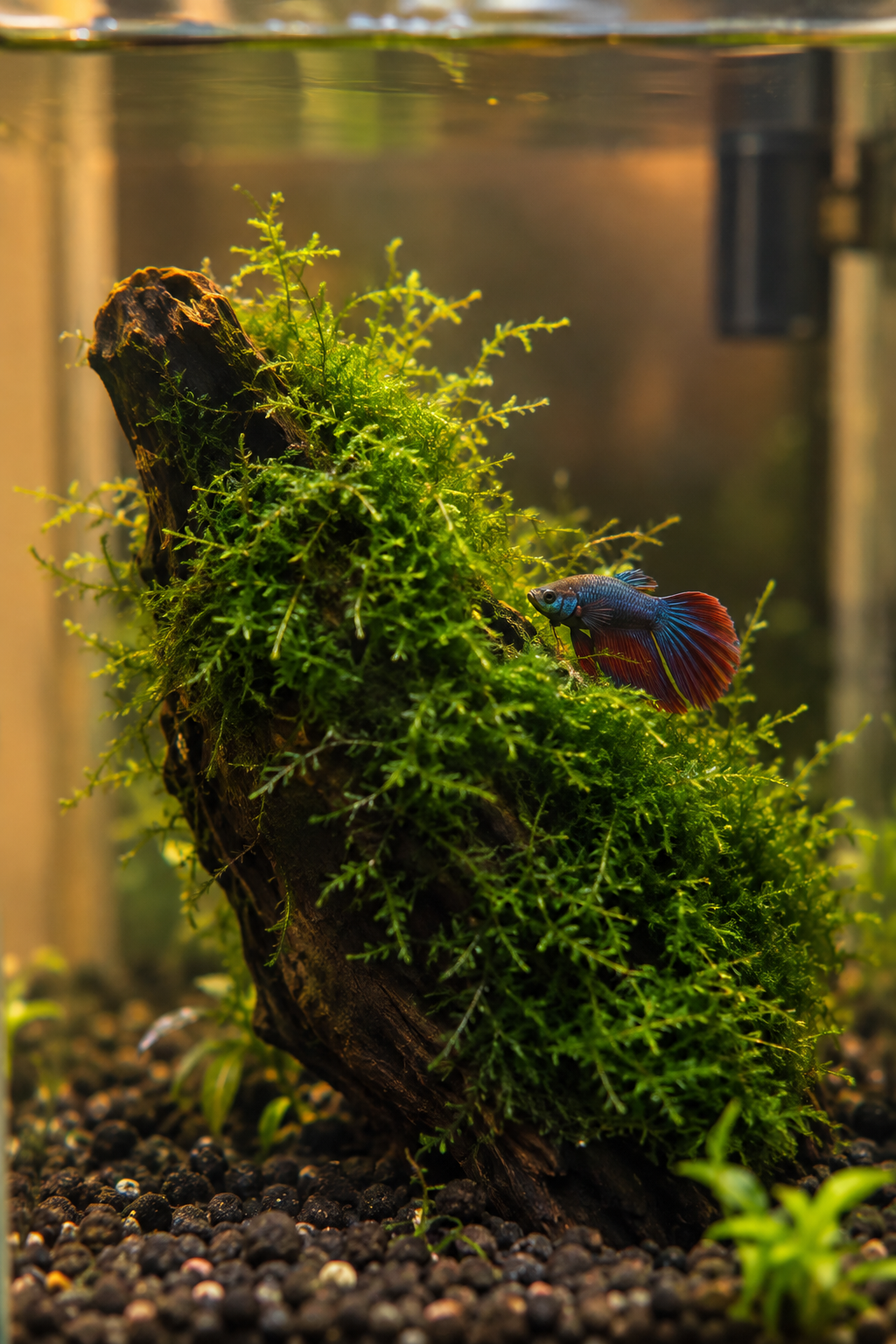
In a tank this small, there's rarely room for multiple decorative elements to coexist without looking cramped, which is exactly why the most successful nano tanks tend to build the entire layout around a single moss-covered feature. A small piece of driftwood or one flat stone wrapped in java moss or Christmas moss becomes the whole visual story, doing the job that five or six separate ornaments might do in a larger tank.
Moss works especially well at this scale because it grows in soft, uneven clumps that instantly look established and natural, unlike a bare rock or fresh piece of wood that can look stiff and artificial in such a small footprint. Tying moss on with thin fishing line lets it fill in over a few weeks, gradually softening any hard edges on the hardscape underneath.
Because this one feature is doing so much visual work, take care with its placement slightly off-center, with a bit of the substrate visible around its base, tends to look far more intentional than centering it dead in the middle of the tank. Once the moss has filled in, this single feature alone is often enough to make a nano tank feel fully decorated without a single additional ornament.
3. Choose Micro Carpeting Plants for Full Coverage
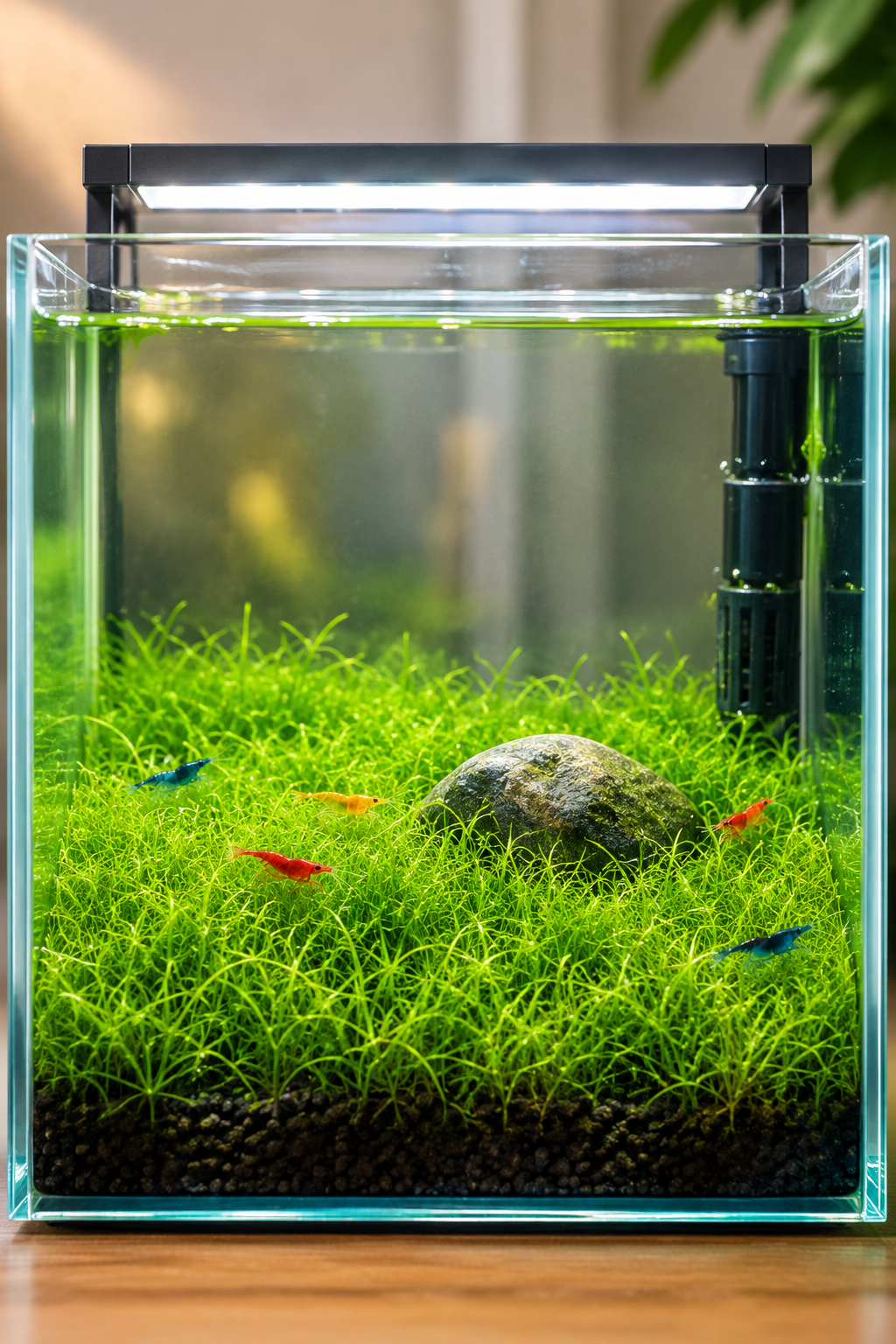
Regular aquarium plants like Amazon sword or large-leafed anubias can quickly dominate a nano tank, but a category of true "micro" plants exists specifically for small-scale aquascaping. Dwarf hairgrass, micro sword, and riccia are all compact enough to carpet the substrate of a nano tank without ever overwhelming the limited space, giving the illusion of a lush miniature lawn rather than a jungle.
These carpeting plants typically need higher light and a nutrient-rich substrate to establish well, so it's worth choosing a small aquarium-specific plant substrate rather than plain gravel if a full carpet look is the goal. Trimming regularly once the carpet fills in keeps growth low and dense rather than tall and straggly, which is what gives nano tanks that neat, manicured appearance.
The payoff for the extra care is worth it: a fully carpeted nano tank floor makes even a bare-bones layout with just one small rock or piece of wood look complete, since the eye reads the green carpet as intentional decor in its own right. It's one of the few nano tank ideas that actually looks better the smaller the tank is, since a dense carpet reads as even more impressive at close range.
Nano Tank Care Tips Worth Knowing
- Watch your water parameters closely. Small water volumes shift temperature and chemistry faster than large tanks, so more frequent, smaller water changes work better than infrequent large ones.
- Choose fish and shrimp suited to small volumes. Species like chili rasboras, celestial pearl danios, and dwarf shrimp are comfortable in nano tanks, while larger or more active fish are not.
- Avoid overfeeding. Excess food fouls a small volume of water quickly, so feed sparingly and remove anything uneaten within a few minutes.
- Trim regularly, not occasionally. Moss and carpeting plants need frequent light trimming in a nano tank to avoid overtaking the limited space between trims.
Final Thoughts
Decorating a nano tank well isn't about fitting more into less space it's about choosing one idea and trusting it to carry the whole display. Whether that's perfectly scaled hardscape, a single moss-covered feature, or a full carpet of micro plants, each of these approaches proves that a few square inches of glass can hold just as much personality as a full-size aquarium, often with even more charm packed into the details.
Frequently asked questions
What size counts as a nano tank?
Most hobbyists consider anything under 10 gallons a nano tank, though the term is most often used for tanks between 2 and 5 gallons, where scale becomes especially important to decorating decisions.
Can I combine all three of these ideas in one nano tank?
It's possible on the larger end of the nano range, but for very small tanks under 3 gallons, picking just one or two of these ideas usually looks cleaner than combining all three at once.
Do nano tanks need less maintenance than larger tanks?
Actually the opposite smaller water volumes are less stable and require more frequent monitoring and water changes, even though each individual task takes less time to complete.
