
The first wall-mounted tank I set up looked oddly out of place for months, even though the mounting itself was solid and the fish were thriving. It took a while to realize the problem wasn't the tank — it was that I'd decorated it exactly like a floor tank, just turned sideways and hung on a wall. Once I started designing around the tank's actual shape and its relationship to the wall around it, the whole thing finally looked like it belonged there.
If you already have a wall-mounted aquarium, or you're planning one, these three ideas go beyond the mounting hardware itself and focus on how to style the tank so it feels genuinely designed for wall display, not just relocated there. Each idea below includes a detailed image prompt so you can visualize the look before making changes.
Why Wall Tanks Need Their Own Styling Approach
A wall-mounted tank's shallow depth, fixed viewing angle, and direct relationship to the surrounding wall all set it apart from a standard floor tank. Decor that works beautifully in a deep, freestanding aquarium can look thin or awkward once it's shifted to a shallow wall display, which is exactly why wall tanks reward a different set of styling choices, both inside the glass and on the wall around it.
1. Design a Vertical-Style Aquascape for Shallow Tanks
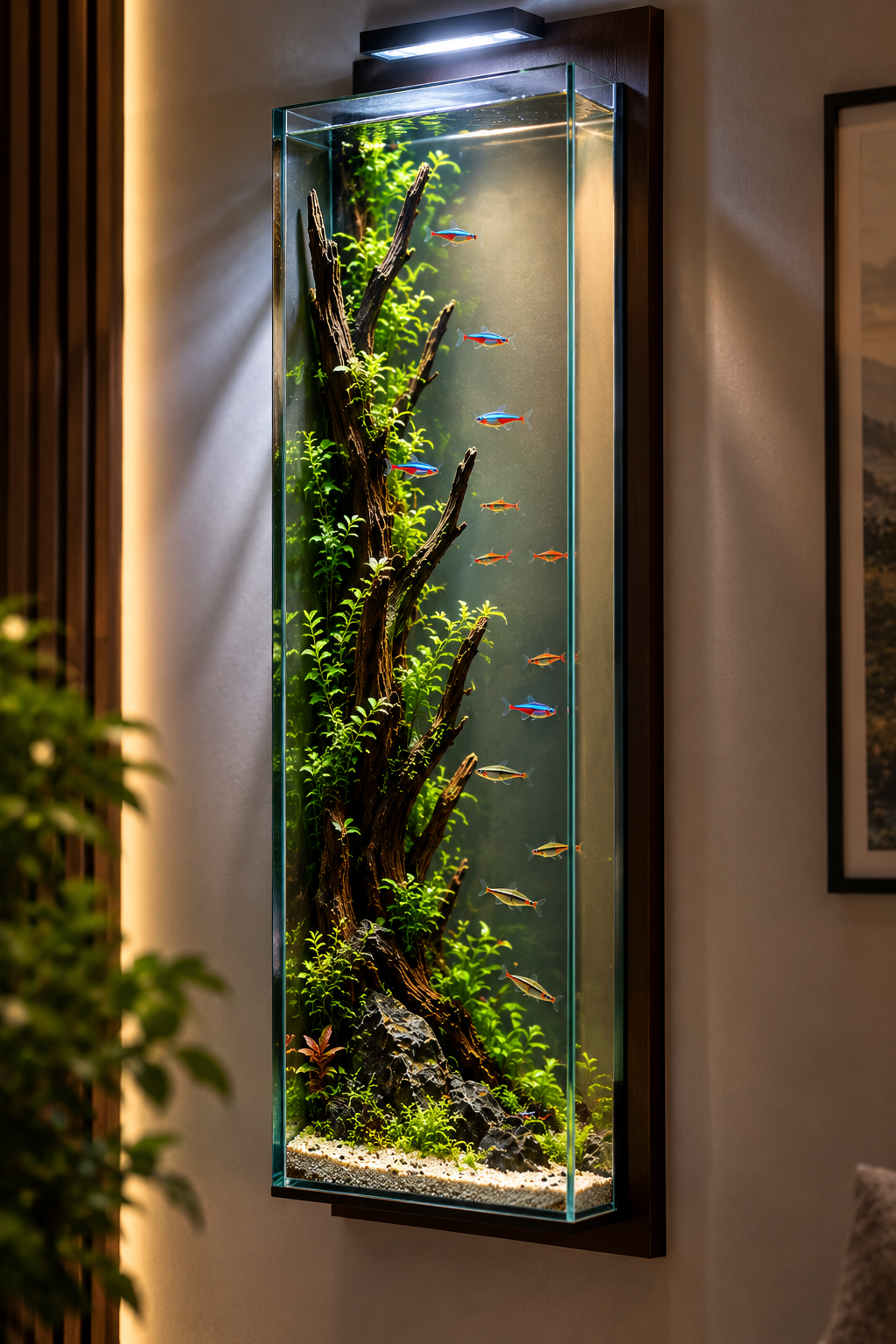
Wall-mounted aquariums are almost always shallow front-to-back, which means the standard aquascaping rules built around wide, deep floor tanks don't really apply here. Rather than fighting that shallow depth, the best-looking wall tanks lean into it, building the layout vertically instead of front-to-back, the way you'd arrange a tall, narrow piece of wall art rather than a spread-out tabletop scene.
In practice, this means choosing hardscape that rises rather than spreads: one or two upright branches of driftwood, or a slim stacked column of flat stones, positioned toward one side rather than centered. This creates a sense of height that mirrors the tank's own proportions, instead of trying to cram a wide, horizontal layout into a frame that was never built for it.
Because there's less physical depth to work with, every piece in a wall tank is seen more clearly and from a more consistent viewing angle than in a floor tank, which people typically look into from above or at a slight angle. Keep this in mind by choosing hardscape and plants with an attractive profile from the front, since that's really the only view the tank will ever be seen from.
2. Blend the Tank Into a Gallery Wall Arrangement
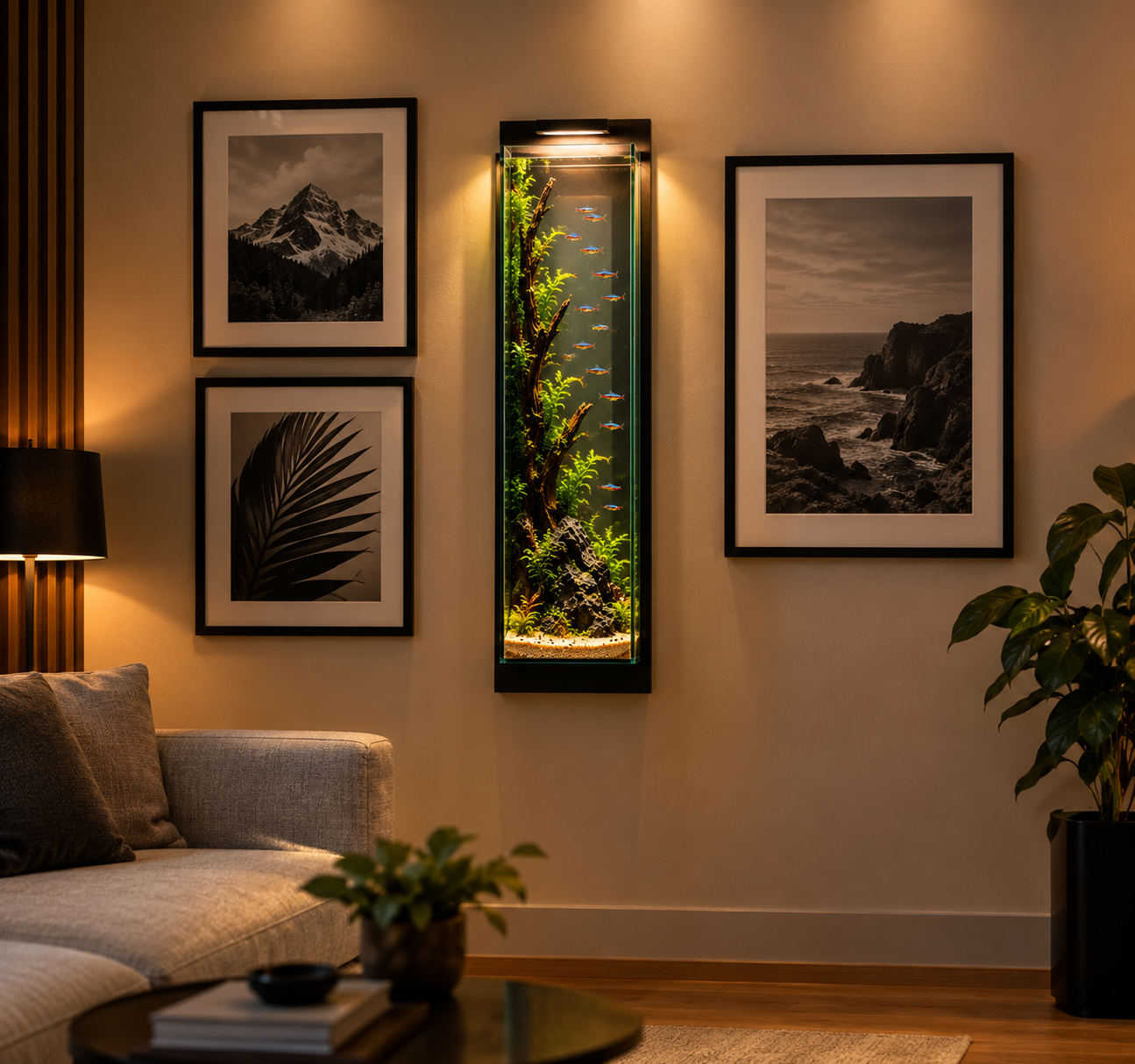
A wall-mounted aquarium doesn't have to stand alone on an empty wall. Treating the tank as one piece within a small gallery wall — surrounded by a few framed prints, a mirror, or floating shelves with small objects — turns it into part of your home's overall art display rather than an isolated fish tank hanging by itself.
The trick to making this work is choosing frame and shelf finishes that complement the tank's own hardware, whether that's a black metal bracket, a natural wood frame, or a minimalist white mount. Matching finishes across the gallery wall makes the aquarium read as an intentional design choice, the same way a framed print would, rather than looking like an unrelated addition bolted onto an otherwise curated wall.
Position the tank at roughly the same height as the center of the surrounding artwork, and leave consistent spacing between each piece, just as you would when hanging any gallery wall. The moving water and fish inside the tank naturally become the focal point of the arrangement, drawing the eye first, while the surrounding art gives the whole display a sense of completeness that a lone tank on a blank wall doesn't achieve.
3. Frame the Tank with Floating Shelf Greenery
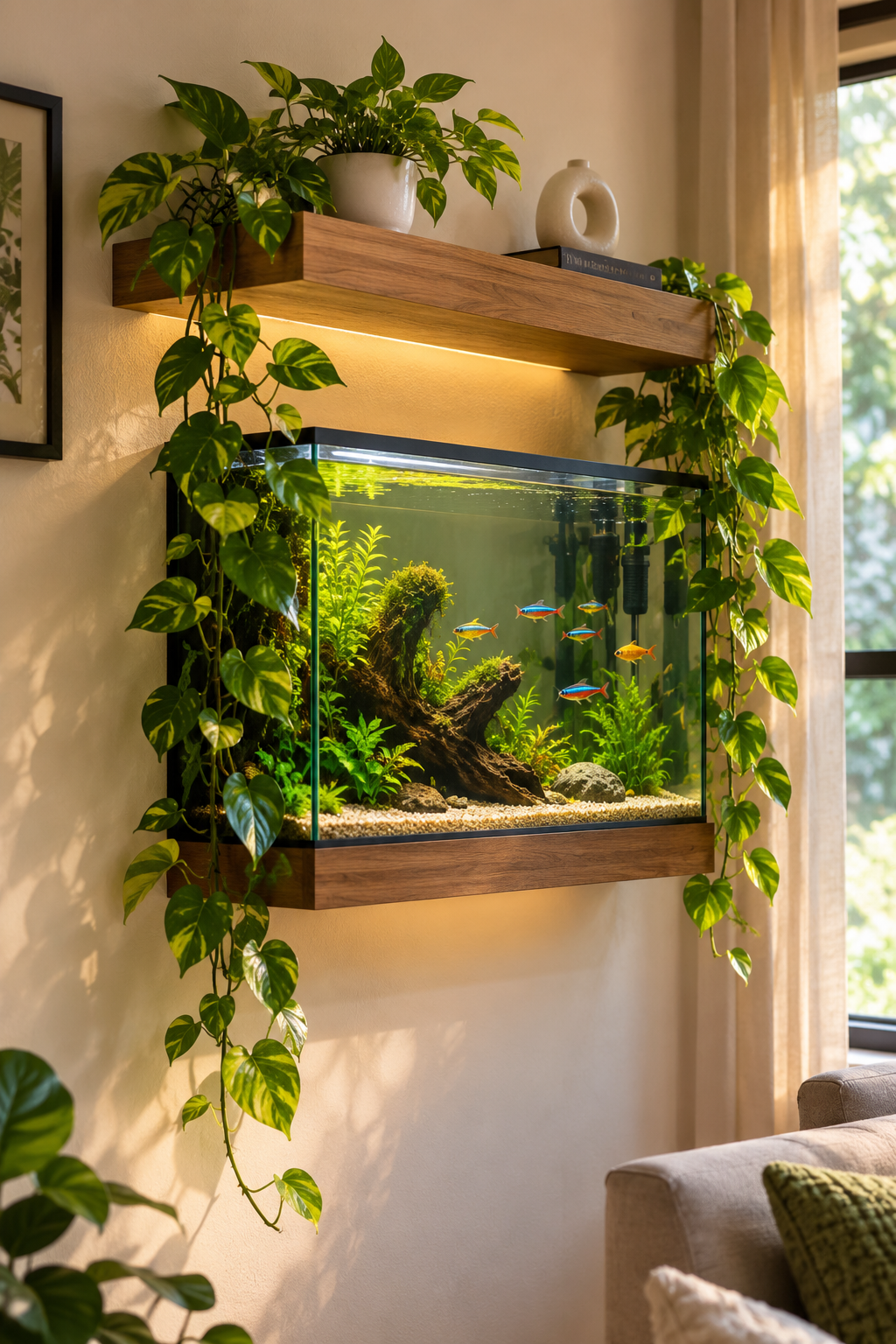
Adding one or two floating shelves directly above or below a wall-mounted tank, styled with small potted plants, creates a green frame around the aquarium that ties its aquatic greenery to the living plants in the room. This is a particularly effective idea for renters, since floating shelves are simple to install and don't require altering the tank's own mounting hardware.
Choose plants with trailing or cascading growth, like pothos or string of pearls, positioned on a shelf just above the tank so their vines drift downward along the outside of the glass. This creates a soft, layered transition between the aquarium and the surrounding wall, blurring the line between the aquatic world inside the tank and the plant life outside it.
Keep the shelf styling relatively minimal — one or two plants and perhaps a small decorative object — so the greenery frames the tank without competing with it for attention. The goal is for the shelf to feel like a natural extension of the aquarium's own plant life, not a separate display fighting for the same wall space.
Styling Tips for Wall-Mounted Tanks
● Think front-facing, not top-down. Every piece of hardscape should look good from the single angle most viewers will actually see, unlike a floor tank viewed from multiple sides.
● Match hardware finishes deliberately. Bracket color, shelf finish, and frame tones around the tank should feel coordinated rather than randomly assembled.
● Keep maintenance access in mind. Leave enough clearance around the tank for lid removal and cleaning before finalizing any surrounding shelf or art placement.
● Light the wall, not just the tank. A warm ambient wall light nearby can enhance the aquarium's glow without competing with its own internal lighting.
Final Thoughts
A wall-mounted aquarium has real design potential beyond simply saving floor space — it can become a genuine centerpiece of a room's wall styling when it's treated as part of the wall, not just attached to it. Build a vertical-style aquascape suited to its shallow shape, blend it into a gallery wall, or frame it with trailing greenery on a floating shelf, and you'll end up with a display that looks intentional from the very first glance, not just functional.
Frequently asked questions
How much weight can a typical wall mount hold?
This varies by product, so always check the manufacturer's weight rating for both the bracket and your wall type, and remember to calculate the tank's total filled weight, not just its empty weight, before mounting.
Can I add floating shelves without professional installation?
Most floating shelves are designed for straightforward DIY installation with basic tools, though it's worth confirming they're rated to hold potted plants securely, especially if positioned directly above an aquarium.
Do wall-mounted tanks need different fish than floor tanks?
Not necessarily, but their shallow depth suits smaller, less active fish best, since deep-bodied or highly active swimming species may find the reduced front-to-back space more restrictive than a standard floor tank.
